
R.E.T.N.A
Decision Governance Protocol
R.E.T.N.A (Real-time Execution Trust and Notarization Architecture) is a decision governance protocol that ensures autonomous systems execute actions only within enforceable policy boundaries.

What the Protocol Does
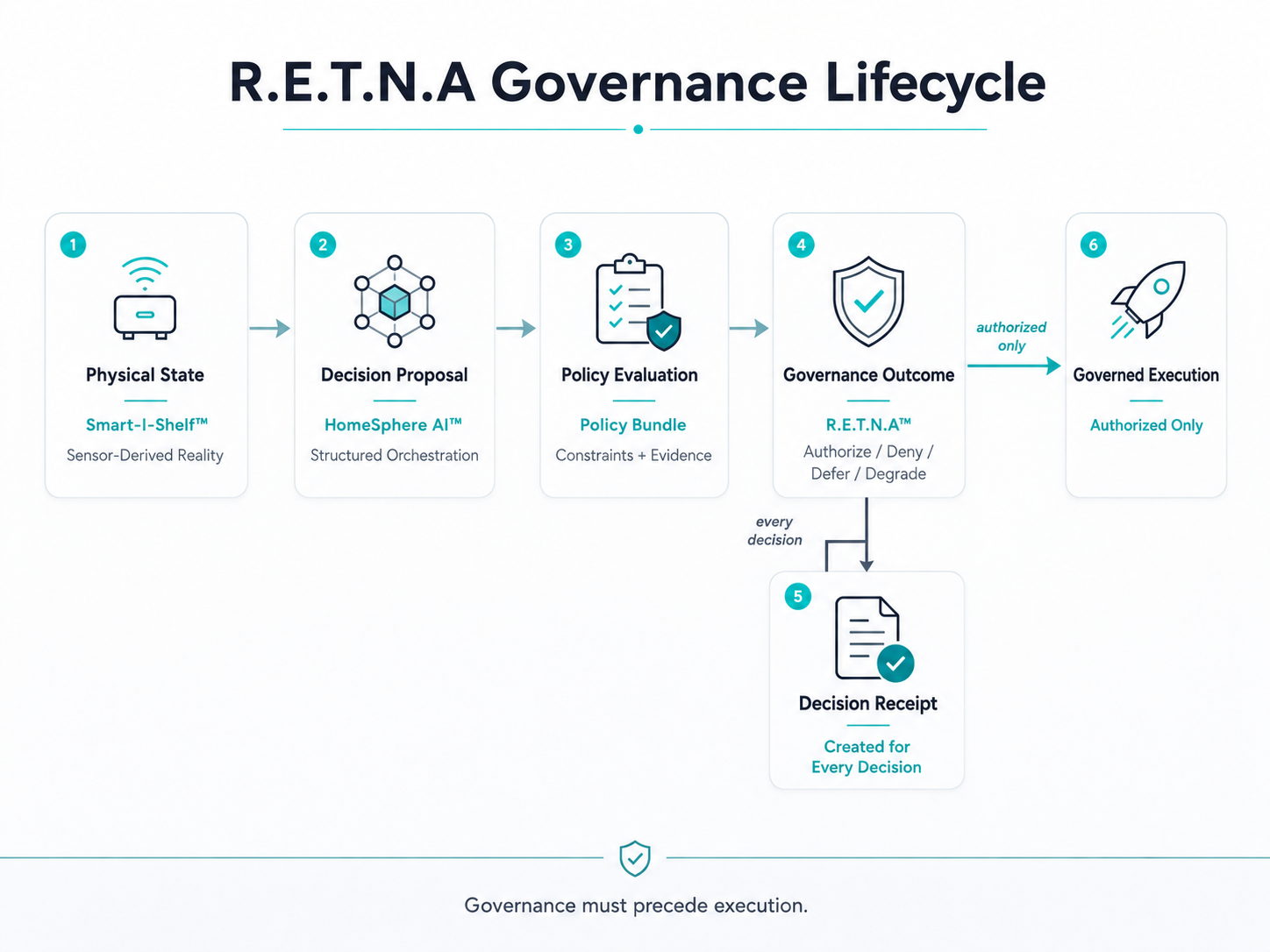
R.E.T.N.A introduces a deterministic governance boundary between decision proposal and execution.
It evaluates autonomous actions against defined policy constraints, risk modes, and evidence thresholds before privileged execution occurs.
The protocol is designed to ensure that governed systems are not only intelligent, but auditable, policy-bound, and regulator-ready.
Core Governance Functions

Pre-Execution Authorization
Evaluates proposed actions before execution and resolves enforceable outcomes such as allow, deny, escalate, defer, or degrade.

Decision Receipts
Generates auditable governance artifacts that record the policy bundle, evidence references, participants, outcome, and rationale for every governed proposal.

Portable Compliance
Supports enterprise auditability, regulator-grade traceability, and independent validation without requiring a single vendor or model stack.
Reference Implementation
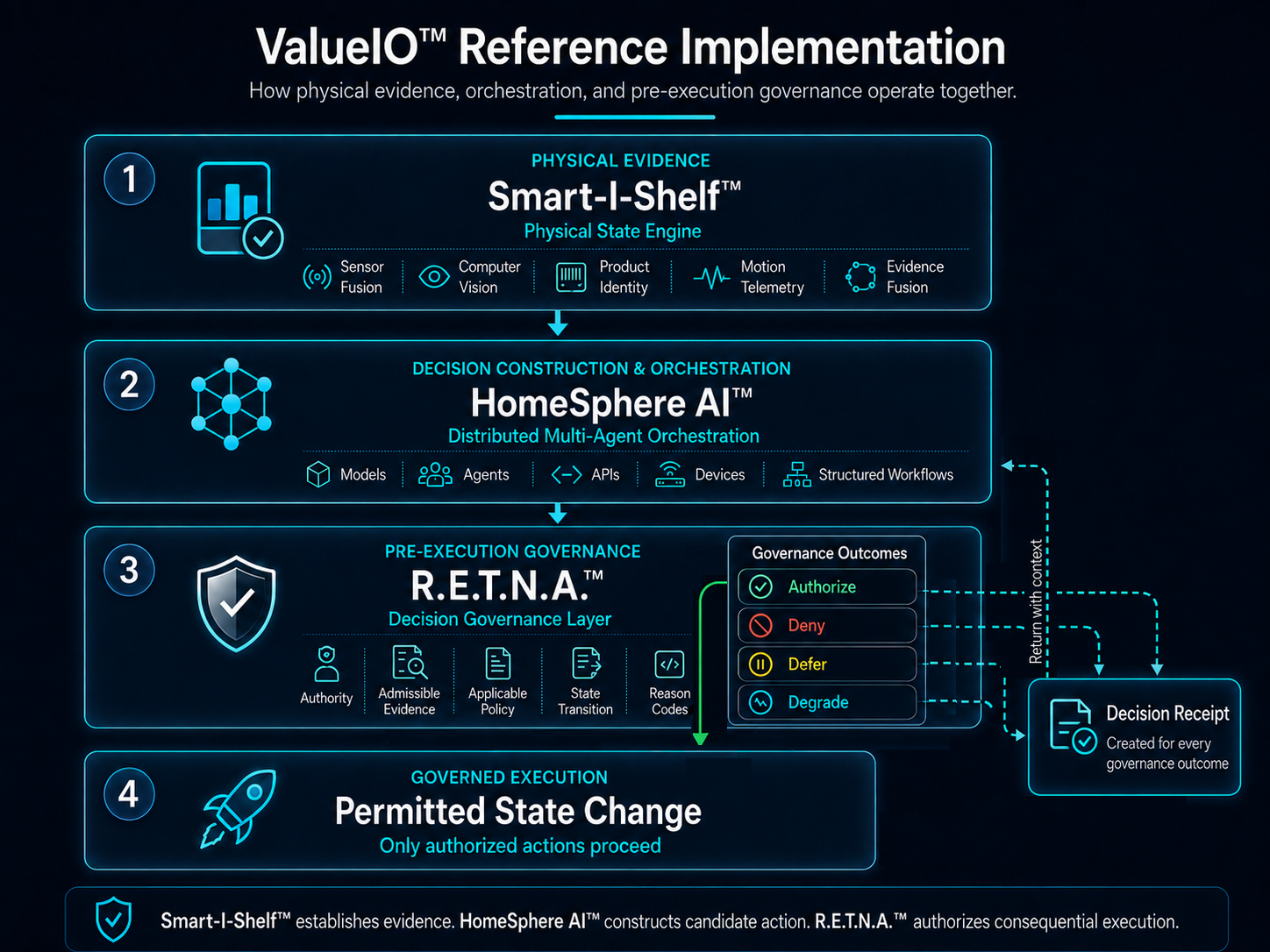
The ValueIO stack serves as a working reference environment for R.E.T.N.A.™, with HomeSphere AI™ providing distributed orchestration and Smart-I-Shelf™ supplying independent physical-state evidence.
It demonstrates how physical evidence, decision construction, distributed orchestration, pre-execution governance, and governed execution can operate together within a real autonomous system.
Smart-I-Shelf™ establishes physical-state evidence.
HomeSphere AI™ constructs and coordinates candidate actions.
R.E.T.N.A.™ determines whether those actions are authorized to become consequential execution.
Governance Compliance Profiles
RETNA A
Baseline governance compliance
Boundary enforcement, receipt emission, outcome enforcement, and reason-code traceability.
RETNA B
Enterprise audit readiness
Evidence integrity, tamper-evident storage, policy version traceability, and export tooling.
RETNA C
Regulated readiness
Attestation, human override traceability, retention controls, and independent validation support.
Protocol Documentation
Request R.E.T.N.A™ + GAI Materials Review Access
The full R.E.T.N.A™ Protocol Specification, Governed Autonomous Intelligence Whitepaper, and supporting documentation are available for qualified review upon request. Public materials describe the protocol's architectural principles, governance model, and selected conformance concepts. Detailed implementation guidance, proprietary policy logic, reference implementation mechanics, physical-state intelligence architecture, and certain technical and commercial materials are shared through a controlled review process with appropriate confidentiality, attribution, and use restrictions where applicable.
Full protocol and whitepaper materials are shared selectively with qualified enterprise, legal, regulatory, OEM, investor, and research stakeholders.
Request Controlled Review AccessHow to review R.E.T.N.A
R.E.T.N.A is presented through two complementary review surfaces: a public technical repository for protocol-level concepts and verification artifacts, and a controlled documentation set for qualified technical, enterprise, legal, regulatory, research, and investment review.
Public Technical Review
The public R.E.T.N.A repository provides an introduction to the Governance Boundary, normative terminology, System Invariants, Decision Receipt model, canonical governance outcomes, interoperability principles, and conformance approach. These materials are intended to demonstrate the protocol’s structure and testability without disclosing proprietary implementation logic.
Controlled Specification Review
Qualified reviewers receiving the complete R.E.T.N.A Protocol Specification should begin with the Abstract and Notice & Intent, followed by Section 5 — System Invariants, Section 8 — The Decision Receipt, Section 14 — Interoperability and Extensibility, and Section 15 — Conformance and Testability. Reviewers evaluating implementation and commercial rights should also consult Section 17 — Licensing and Implementation Rights.
The Governed Autonomous Intelligence Institutional Whitepaper provides the broader architectural and market thesis connecting deterministic physical state, distributed orchestration, and pre-execution Decision Governance Infrastructure.
Public artifacts establish the protocol surface. Controlled materials provide the deeper specification and implementation context.
Governance Must Precede Execution
R.E.T.N.A introduces the missing governance layer required for autonomous systems to operate safely in real-world environments.
By enforcing deterministic authorization boundaries, auditable decision receipts, and policy-bound execution, the protocol transforms autonomous intelligence into accountable infrastructure.